
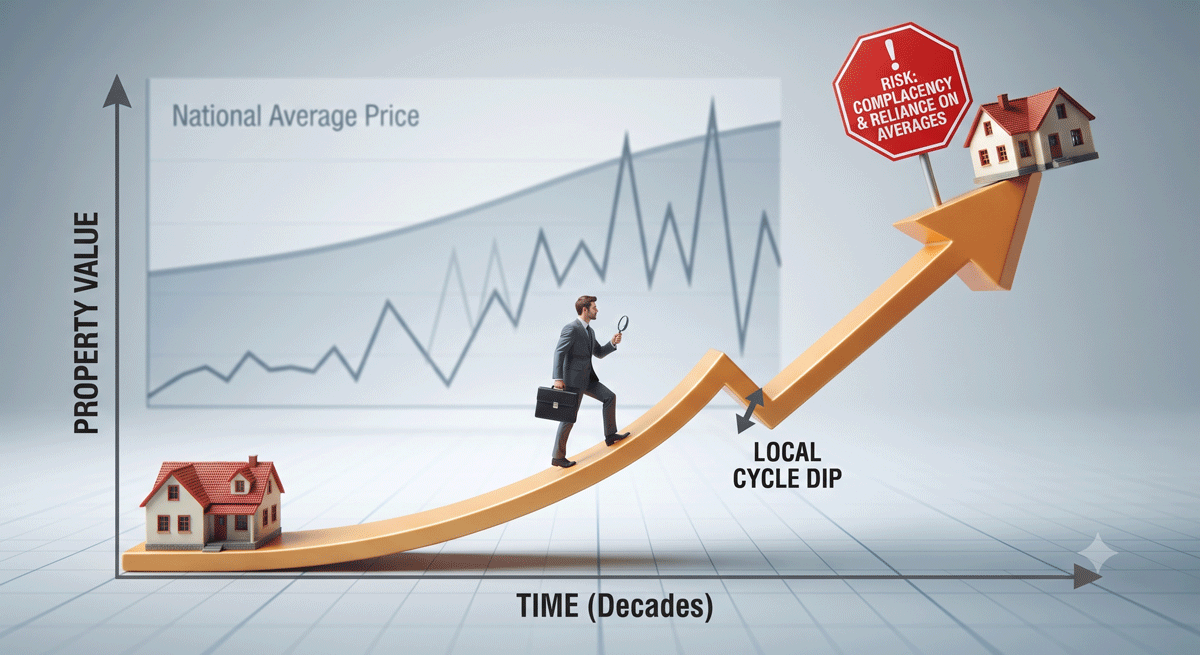
It's a Myth That Property Prices Always Go Up
“Property always goes up in the
long run” is one of the most repeated lines in Australian real estate — and
like most things repeated often enough, it's treated as fact rather than
examined as a claim.
It's not entirely wrong. But
it's not the whole picture either, and believing it too literally leads to some
genuinely costly decisions.
“Long run” can be a lot
longer than people assume. National
median prices trending upward over 30 years says very little about what happens
to one specific property over the 5–10 years an individual actually holds it.
Markets move in cycles, and some cycles are long. A property bought at the top
of a local peak can take years just to get back to the price paid for it —
that's not decline, but it's also not the growth the narrative promises.
Averages hide enormous
variation. “The market” isn't one
thing. A capital city average can be climbing while specific suburbs within it
are flat or falling, because of oversupply, a single dominant employer
struggling, or a decade of overbuilding in that exact pocket. A property
doesn't grow because the country's average grew — it grows (or doesn't) based
on the specific and often unglamorous fundamentals of its own suburb, street
and dwelling type.
Growth isn't guaranteed —
it's a probability, shaped by fundamentals.
Population growth, employment diversity, infrastructure, supply
constraints, and genuine (not promised) demand are what drive growth. A
property bought without checking any of these isn't investing on fundamentals —
it's investing on faith that the general trend line will do the work.
The real risk isn't that
prices fall. It's that people stop checking, because they assume they don't
need to. “It always goes up” becomes
a reason to skip research rather than a reason to do it — which is exactly
backwards. The buyers who do best over time tend to be the ones who never
stopped asking why a specific property should perform, rather than assuming it
automatically would.
None of this means property is a
bad long-term asset — historically, it has been a strong one for many people.
It means the phrase “property always goes up” is a comforting simplification of
something that is, underneath, driven by specific, checkable fundamentals — and
treating it as a guarantee is where the real risk lives.